In this episode, Daniele Strippoli, ERM’s EMEA Nature and Water Lead, joins Mark Lee to discuss the role of nature in the recent Milano Cortina Winter Olympic Games. Together, they discuss what major sporting events can reveal about valuing natural capital, understanding ecosystem dependencies, and shaping decisions that support both communities and the environments they depend on.
Their conversation covers:
- How nature can shape major sporting events
- Balancing infrastructure, communities, and the environment
- Natural capital accounting and future of climate-resilient games
Subscribe to the podcast
Podcast transcript Hide
The transcript highlights below have been edited for clarity
Mark Lee
Welcome to this next episode of the Sustainable Connections podcast. I'm Mark Lee. I'm the Global Director of Thought Leadership at ERM. Today we have a bit of a different play on the Sustainable Connections theme. We're often making connections between people and organizations that are partnered in the sustainability field or offering perspective on events within the field, like a recent podcast on the GreenBiz Conference in Arizona.
Today, we're talking about the connection between major human events and nature. We're going to do that by taking a quick look back at the Milano-Cortina Winter Olympic Games that just took place. It may have consumed some of your television and other media time in February, as it did mine. Lots of exciting events from unbelievably heroic Norwegian skiing, setting all-time Olympic records, through to terrifyingly close hockey games to wrap things up at the end. The Winter Olympics is one of our most iconic global events. But I do think they're one of the ways that we can look at how deeply human activity depends on natural systems. Of course, in this case, snow reliability, mountain landscapes, water, climate stability, they all have an impact on how events like this take place. As climate and nature impacts and pressures on society and business intensify, we're probably going to see more of this over time.
To explore this intersection, I'm delighted to be joined by Daniele Strippoli. He is a partner in ERM, based in Milan. He's also our nature lead for EMEA. He's been thinking for a long time about what events like this can teach us about valuing nature, integrating natural capital approaches, and especially perhaps preparing for a changing climate.
Daniele, first of all, welcome. Thank you so much for joining me. I understand you're sitting in an airport today, so we might be navigating a bit of background noise. Please say hello and tell us about what that nature lead job means inside ERM.
Daniele Strippoli
Yes, thank you, Mark. I'm very pleased to be here today. My nature job at ERM means organizing end-to-end solutions for our clients to understand the risk, to embark from a risk identification to actions, and to define what actions mean across their operational value chain. At the end, it’s really about future proofing business resilience to the exposure at risk for the natural asset, organizing solutions across value chains in the ecosystem of corporations, cross-services, and connecting the financial dimension with the corporation agenda. It’s quite a busy time in the market for this, but very interesting and innovative as well.
Mark Lee
That sounded far more than one person's job! Given the Olympics just passed, and you were a spectator as well as a nature expert, do you have a favorite winter sport or a moment from the Olympic Games that really stood out for you?
Daniele Strippoli
That's a very interesting question, those who know me well know that I'm very passionate about sports with a focus on endurance. I'm preparing next week for my first marathon on Nordic skis in St. Moritz. My favorite sports moment and event was in Tesero, watching the relay marathon on skis. That was won by Norway, but Italy scored third place. I was very proud, especially being in a nice environment with my boy, and recognizing how beautiful nature is and how beautiful nature is when it's connected to people and sport activities. So, it was a very nice setup and atmosphere there.
Mark Lee
Fantastic, and we should pause to acknowledge that for all of Norway's Winter Olympic dominance, Italy really had a fantastic Winter Olympics. From the opening day on through, it was an incredible performance.
Daniele Strippoli
That's correct.
How nature can shape major sporting events
Mark Lee
Shifting into our topic today, the connection between human events like the Winter Olympics, what we might call a mega event, global in scale and in some of its planning and construction. Given your perspective as a nature expert, what was it like to watch an event of this scale take place? The buildup takes years and at the very early stages, what were your expectations of what the game's impacts on nature might be?
Daniele Strippoli
That's a very interesting question. For context, I was very proud. I think it was six years ago when there was the announcement of Milan being awarded for the events. I was in the city center with the live award ceremony. I thought to myself, this is a big opportunity for the city. It's a big opportunity for us to show the beauty of Italy, the beauty of nature. I think when I say beauty of nature, I'm speaking about what are, let's say, the different assets associated with the concept of nature, () and the importance of nature as an asset, as provisioning of cultural services, and the complexity of nature in a way. The expectation was that we are speaking about a spread-out Olympic Games. I know that the Olympics has this expectation to leave a legacy, post-event. A question I had for myself was, how could this be addressed? Because, in the end, the Olympics needs big infrastructure work to cope with a high presence of people in a concentrated time period in time. So it's a little bit challenging.
So, I think this was all in my mind when I was thinking on the concept of the complexity of building such infrastructures, at the same time optimizing the use of land, and leaving legacy to future generations, in the context of climate change. The climate is changing. So in this context, I think there was a lot of complexity. It was refreshing to see the effort made to try to do their best, at the same time manage the complexity, and try to implement operational actions, while building the infrastructure in a way that was effective for future opportunities. Sometimes with good outcomes, sometimes maybe if I can be a little bit criticizing here, I have some personal considerations.
Mark Lee
Yeah, and sometimes we won't know whether those facilities worked for a long time. I was struck that it was the curling arena in Cortina that had been built in the 1950s for a prior games and then became one of the really popular hubs with the fans because of the noise and the characteristics of the old building. We hope that some of the facilities built this time will age as well.
You mapped so many things there, Daniele, and almost like your intro to your role, one of the themes is complexity. So, dealing with complexity, often it helps to have some good tools. You work a lot on valuing natural capital and ecosystem accounting. Did those tools and approaches have meaning in the context of the Olympics? Can you explain how those concepts might apply to something like planning a Winter Olympics event?
Daniele Strippoli
Yes, I think they have a lot of connection with the planning of an event like this one. What we mean by natural capital, we mean the opportunity to associate an economic value to the concept of natural resources. For nature, we define it as a very complex, situation, where there is biodiversity, there is water, there are natural resources, but there are even more important ecosystems from an ecological standpoint and ecosystem services from an accounting standpoint.
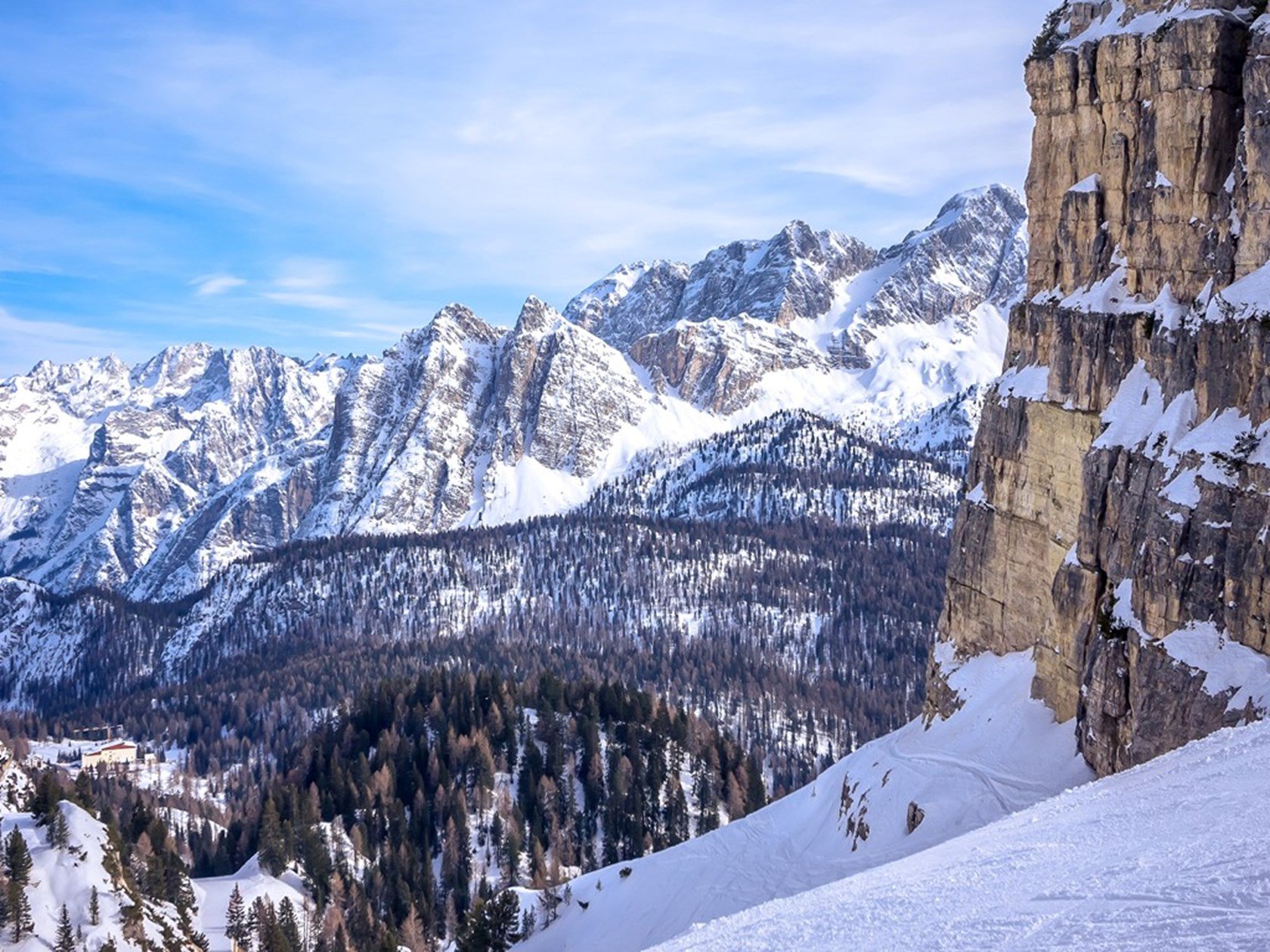
What is an ecosystem service? An ecosystem services is a service offered by nature to us as a community, as a business, as citizen of the world, to rely on provisioning or supply, from nature to us. There are some that are very simple, some that are a little bit more complex. But just in the context of the Olympics, the opportunity to see a nice landscape, to see a nice mountain view, etc, this is a provisional ecosystem service that speaks about the value of nature from a landscape perspective. And this creates interest for tourism. This creates attraction for people. This creates a real economy for those who live in the valley.
Clean water is another clear example of ecosystem service. So, water is cleaned up by nature, and water needs to be available in quantity, quality, seasonally for the purpose of a game, for the people joining the events, to see the events, and to support the event organization. But also, for suddenly making artificial snow, because we know that snow sometimes needs to be made artificially. I can continue for hours, but at the end we're speaking about connecting the variety of biodiversity and the role of nature to provide us something that can be valued. I think you can understand why natural capital and ecosystem services can be important in planning an event like this one.
Mark Lee
Perfect and I thought it was really helpful to have two quite different examples for water. And if you were watching on TV, especially in the first week of the games, you could just see that the areas surrounding the event facilities on the mountains were barren. And that snowmaking had been incredibly important to have the venues prepared. Then, of course, at times in the second week, there was too much snow. I really like the introduction of the natural landscape and its aesthetic appeal and how that intersects with economies as a way to bring that concept to life.
Daniele, is there a way in which something like the games depends on natural systems that people don't always think about? If water or the landscape is a bit more obvious, what are some of the more subtle ways that nature supports a mega event like this?
Daniele Strippoli
When you speak about dependencies at the end, you have to think that everything that is available to us in the market, in the real economy, has strong dependencies of nature. I don't want to enter the value chain element here because we're not speaking about the typical work we do with a corporation, where we try to define where the commodities come from, if there is a critical exposure to climate change, etc. In the context of the Olympics, I think it’s a little bit different, the situation here, there is a lot about what is the role of the natural asset to provide the real user experience to the Olympic Games. We spoke about the water, the landscape, as you mentioned, but it's not only that.
Sometimes when we think about dependencies, we think about the supply of palm oil, in a given value chain, at the end. The dependency concept is by far more complex. I’m speaking about the role that nature plays to allow human beings to be safe in communities for the long term.
Balancing infrastructure, communities and the environment
Mark Lee
Yeah and as climatic conditions change and snowfall patterns shift, you mentioned avalanche, and we just had a terrible avalanche situation in Northern California. A group, very experienced, with guides were caught in an avalanche, nine people killed and it was a situation where we had very little snow, icy slippery surface, then several meters of snow dropped on top, and it just slipped away and crushed this group. So we need to learn to interact with nature differently as climatic conditions change as well.
You brought in some of the people elements, Daniele, and I wonder, when we think about resources, often we think about resource competition. Do you see or have an observation on how the Olympics and their planning take social considerations and community considerations into account? Along with the environmental, because of course, the community needs the same water that was being used to make snow.
Daniele Strippoli
When we speak about the concept of natural capital, we speak about, the local communities, the people agenda. Because at the end, I think natural capital is really about how you use the land, the natural resources to provide financial flow to the local territories through the value of nature. That is a resource, it is an asset to be valorized and to be protected. In the context of the Olympics, I think the infrastructure development went through some larger licensing and permitting processes. There is still space in the agenda to ensure that the social dimension and the role of ecosystem, and the natural capital dimension is captured at scale. This is what I meant before when I said that I've seen some things done well, working well, and some less. I think the concept of spreading out the Olympics across the territory was a good idea. I think this gave the opportunity to avoid concentrating a lot of people and a lot of infrastructure in the same territory. At the same time, try to valorize as much as possible what exists and hopefully try to leave a legacy to the territory where legacy is needed.
But at the same time, I've seen some situations where the management of the associated impacts related to the new infrastructure, perhaps was not perfect, if I may. I think this is a huge challenge for the future because I do believe that the Olympics game is a life changing experience, especially in some economies and can really steward some future safeguarding for communities that live in very complex environments, especially for the winter games. I know they are working on that, but I don’t think we are at the state-of-the-art yet, if I may. And I see more of the market trying to address climate, nature, and social agenda together. Sometimes we speak about Just Transition. I think there is a Just Transition opportunity for the Olympics, and maybe it was not fully captured this time.
Mark Lee
Maybe that needs to be considered more in kind of the legacy planning for the Olympics, that when you're starting the process, you're already thinking about the people impacts at the end of it and in an integrated fashion.
Daniele is integration the challenge? Is there something that the Winter Olympics and events like it can teach us about the need to make that climate, nature, and social considerations planning come together differently?
Daniele Strippoli
This is my personal view about what I see in the market. I strongly believe that when we address the nature agenda, we speak about the systemic challenge that requires connectivity among different users of the same territory. When we speak about these large events, we speak about how to integrate these in an even more complex agenda, as you said, climate, nature, social together. To me, this is a real opportunity, if you think about the return of investment of the Olympics, let's imagine in the future that you plan for every dollar spent and the outcome. The outcome is increased value of an asset. What is the asset? It’s the natural capital? And the natural capital describes the nature element, the social agenda, because we speak about the ecosystem services to local communities, to society, but also speaks about climate resilience if well addressed. How to future proof the facilities to climate change. For example, I think a role to play in the Winter Games for the Olympics is also to help people understand that it's not only downhill ski that is interesting in the agenda. Downhill ski is suffering a lot from climate change. There are other interesting activities to be to be done outside in the winter time. There can be an opportunity to revisit infrastructures of some venues to be future proofed for climate change. While protecting the natural capital and increasing the biodiversity protection, at the same time increasing the livelihood of local people, that will have long term safeguarding of their interest in the valley. Maybe it looks a little bit too far, but I strongly believe that this could be an equation for the next generation of games.
Natural capital accounting and future of climate-resilient games
Mark Lee
It sounds like there's the potential there for what we learn about climate resilience, adaptation and mitigation through planning things like the Olympics to bring benefits back to the community and the society as well, as long as we're intentionally doing that.
Danielle, I know we're a bit pressed on time. I'd love to try and fit in two more questions if I can. And the first one takes us back to natural capital accounting. We touched it briefly more towards the start. I wonder if there's one or two examples you could give us of how natural capital accounting could help us improve planning and decision-making for future Olympics or future things like it?
Daniele Strippoli
I think it's a very good question. Yes, I see that. To me, I can trade off what we are doing in the mining sector for other, let's say, regional planning and asset site identification. To me, at the end it’s about putting the value of nature as part of the regional planning, the zoning, and the siting. Making sure that you are not just only mitigating the impact that you can of course calculate. How to offset the biodiversity - I cut down the forest, but I balance with new nature. On paper it’s good. But what if we start a different way to consider the zoning and the planning of the facility development from a view that captures, the dimension of the natural capital as a driver for decision making.
Mark Lee
Great and one of the things I heard in that last reply, Daniele, was there's another need to connect more locally that you emphasize putting it into regional plans and sometimes these mega events, at least in the media, they get captured as being very strongly pushed by national governments and the local considerations aren't fully taken into account.
Daniele, I started by asking you about an Olympics moment and favorite sport. Now I want to close with something personal too, and that's to ask, how has your own view of nature's value evolved through your own experiences with the Olympics?
Daniele Strippoli
That's an interesting question. I'm an expert in the field, so I think my view has been truly endorsed from the perspective of seeing Italian beauties, Italian Alps, in the media, on the TV, and speaking with clients, colleagues across the world. Valuing this, not only from the performance of athletes, but also from, what does it represent? And this was a reassurance, but it was also interesting to be at one of the events with my boy. It was funny because we had to park the car into a temporary parking lot and there were some temporary facilities to avoid damage to the soil. I explained to him what it means, why this was done, and what is the concept of temporary siting without jeopardizing biodiversity to protect the soil health for the next cycle in the spring. And to me, it was an opportunity to transfer a little bit of my work experience into my personal life, to my family, to my close ones. I hope he will bring it up somehow at school with his classmates.
I think there was also a very good effort on communicating a narrative around sustainability at the games. I was quite proud of it, with a lot of attention to the selection of material, the recycling, etc. I think these events are events that are once in life for some people. And if you see that there is some structured approach to problems that we see are connected to us, especially for the young generation, well maybe this is a legacy concept, different from the infrastructure legacy, but still very important. Maybe even more important, I think.
Mark Lee
Lovely way to wrap Daniele, and great to hear about your teaching moment with your son, kind of an intergenerational passing on of knowledge there. One thing you mentioned earlier too, it would be remiss in closing today if we didn't wish you well with your own Nordic Ski Marathon upcoming. How far are you going to go? Is this 30K? Is this 50K?
Daniele Strippoli
No, it's a real marathon. It's 42.195 kilometers.
Mark Lee
Oh, fun, but on skis?
Daniele Strippoli
Yeah, on skis.
Mark Lee
Traditional marathon distance on skis. I hope that goes exceptionally well. I can't wait to hear.
To all our listeners, thank you for hanging in with us today. We hope these observations on nature, climate, and community through the lens of the Winter Olympics were interesting and illustrative for you.
===END===