
 View all
The mining sector has long occupied the centre of climate reporting debates. As one of the most emissions-intensive and climate-exposed sectors in the economy, mining companies face significant scrutiny from investors, regulators and communities regarding how they identify, assess and manage climate-related risks and opportunities. The introduction of mandatory climate reporting under AASB S2 (climate-related disclosures) has further accelerated expectations for more consistent, decision-useful disclosures.
ERM’s analysis of more than 30 ASX-listed mining company disclosures across calendar and financial year reporters indicates that mining is now among the strongest reporting sectors. The sector achieved an average overall score of approximately 80%, outperforming corporate, finance, infrastructure, manufacturing and public sector cohorts, and trailing only the highest-performing property and energy sectors. Indeed, the highest rated report in the entire suite of 171 disclosures belongs to a mining company. Mining's strength lies not simply in reporting climate risks, but in its ability to integrate climate considerations into strategy, capital allocation, scenario analysis and operational decision-making.
Despite these achievements, important opportunities remain. As reporting maturity increases, mining companies can learn valuable lessons from other sectors that excel in areas such as transition planning, Scope 3 emissions disclosure, opportunity management and performance measurement.
Mining's key strengths
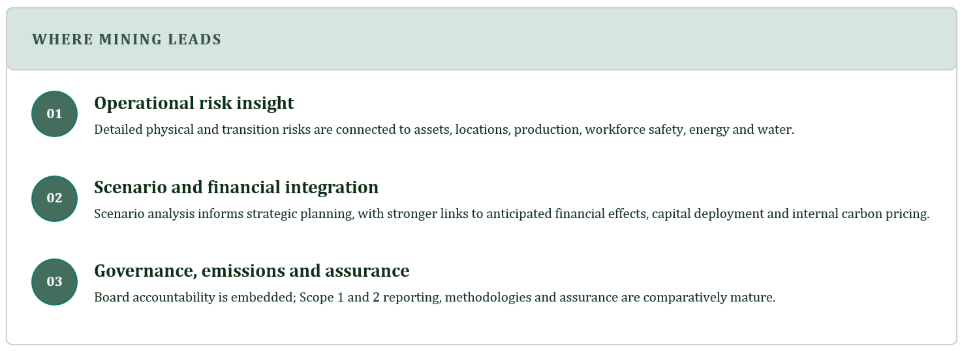
Perhaps the most significant strength of mining disclosures is the depth and sophistication of climate risk identification. Mining companies consistently provide detailed discussions of both physical and transition risks, often linking them directly to specific assets, operations and geographic locations. Water scarcity, drought, extreme heat, flooding, cyclones and bushfires are commonly identified physical risks, while carbon pricing, environmental regulation, fuel costs and low-carbon technology deployment feature prominently as transition-related considerations.
This operational focus gives mining disclosures a level of practicality that is sometimes less evident in other sectors. Rather than describing climate risks in generic terms, mining companies frequently explain how those risks could affect production, infrastructure, workforce safety, energy supply or access to water. This makes the disclosures more relevant to investors seeking to understand how climate issues may affect future business performance.
A second area of strength is scenario analysis. Mining companies scored exceptionally well on climate resilience assessments and scenario-related criteria. Most organisations demonstrated a clear understanding of how different climate pathways could affect future operations, demand patterns and financial performance. Scenario analysis was often integrated into broader strategic planning exercises rather than treated as a stand-alone compliance activity.
Mining also performs strongly in connecting climate issues to financial and capital allocation decisions – often referred to as the financial quantification (‘fin quant’) challenge. Compared with the wider dataset, mining companies show greater maturity in discussing future capital deployment, anticipated financial impacts of climate risks and the use of internal carbon pricing mechanisms. This reflects a recognition that climate considerations increasingly influence long-term investment decisions, project economics and asset development strategies.
Many mining companies have also developed robust governance frameworks. Board oversight, management accountability, charter integration and climate-related decision-making responsibilities are generally well established. Climate considerations are increasingly embedded within governance structures rather than managed separately through sustainability functions. This is reflected in extremely strong governance scores across the sector.
Finally, mining demonstrates strong performance in emissions reporting and assurance. Scope 1 and Scope 2 emissions disclosures are generally comprehensive, calculation methodologies are well explained and assurance arrangements are clearly disclosed. The sector has developed strong capabilities for measuring and reporting operational emissions because these metrics are directly connected to core business activities and regulatory obligations.
Areas where mining can learn from other sectors
While mining performs strongly overall, the analysis also highlights several areas where other sectors are demonstrating more mature practices.
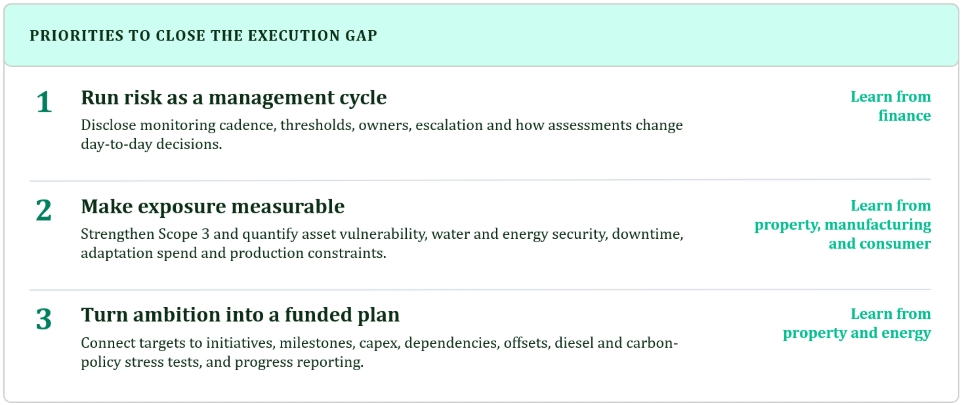
One important opportunity relates to climate risk management processes. Mining companies are often excellent at identifying risks and undertaking sophisticated assessments, but less comprehensive in explaining how risks are continuously monitored, updated and managed over time. In contrast, financial institutions frequently provide clearer descriptions of governance cycles, escalation pathways, ownership responsibilities and periodic review mechanisms. Finance-sector disclosures often explain not only what the risks are, but how they are actively managed and reassessed.
Mining companies could strengthen disclosures by providing more information on monitoring frequencies, trigger thresholds, accountability structures and how climate considerations influence day-to-day risk management activities.
A second learning area is Scope 3 emissions. While mining companies generally report Scope 1 and Scope 2 emissions very effectively, Scope 3 disclosures remain more variable across the sector. Manufacturing, consumer-facing and retail organisations often provide more extensive explanations of value-chain emissions, supplier engagement programmes, data-quality challenges and methodologies used to estimate indirect emissions.
Given the significance of downstream emissions for many mining products, improving Scope 3 transparency represents one of the largest opportunities for mining companies to enhance climate reporting credibility.
Property-sector organisations provide another useful benchmark. Real estate companies frequently link physical climate risks directly to asset-level exposure metrics such as flood risk, resilience investment requirements, insurance implications and adaptation planning. Their disclosures are often highly quantitative, reflecting the direct relationship between climate hazards and the value of physical assets.
Mining companies already assess physical risks extensively, but many could further strengthen disclosures by introducing more measurable indicators of vulnerability and resilience. Examples could include energy and water-security metrics, asset-level exposure estimates, operational downtime indicators, adaptation expenditure or climate-related production constraints. Many mining companies are grappling with the challenges of mine lives that do not extend to 2050 which proves a challenge in the context of long-term reporting requirements.
Another area for improvement concerns targets and performance reporting. Metrics and targets remain the lowest-scoring pillar for the mining sector. Although many companies have established emissions targets, disclosures often provide less information on implementation pathways, milestone achievement, target revisions and the role of offsets. Some reports identify an end-state objective without fully explaining how progress will be measured and reported over time.
Manufacturing and energy sector leaders often provide stronger examples of target governance, methodology disclosure, investment requirements and progress tracking. Their reporting creates a clearer connection between strategic ambition and practical execution.
Perhaps the most important learning opportunity relates to transition planning. Mining companies generally perform well in discussing climate scenarios, identifying strategic responses and describing future risks. However, many still stop short of presenting a fully developed transition plan. While risks and opportunities are identified, the implementation pathway is not always described in sufficient detail, for example, stress testing the business model for different diesel prices, or changes in carbon policy.
Leading reporters in sectors such as property and energy increasingly provide information on key initiatives, capital requirements, timelines, dependencies, governance mechanisms and expected outcomes. These disclosures help investors understand not only where the company intends to go, but how it plans to get there.
Looking ahead
The mining sector has made substantial progress in climate disclosure maturity and is emerging as one of the strongest performers under the AASB S2 framework. Its strengths are rooted in operational realism, rigorous scenario analysis, integration of climate considerations into investment decisions and strong governance structures. These attributes reflect a sector that increasingly views climate risk as a strategic business issue rather than a reporting exercise.
The next phase of maturity will require mining companies to build on these foundations by strengthening transition plans, improving Scope 3 disclosures, enhancing risk-management transparency and providing more detailed performance metrics. In many respects, mining has already mastered the challenge of understanding climate risk. The opportunity now is to demonstrate, with greater clarity and precision, how those insights translate into measurable action and long-term value creation.
As climate reporting continues to evolve, the highest-performing mining companies are likely to be those that combine the sector's traditional strengths in risk and capital management with the more advanced transition-planning and performance-reporting practices emerging in other sectors. That combination would place the industry not only among the strongest reporters, but among the leading practitioners of climate-related corporate disclosure.