
 View all
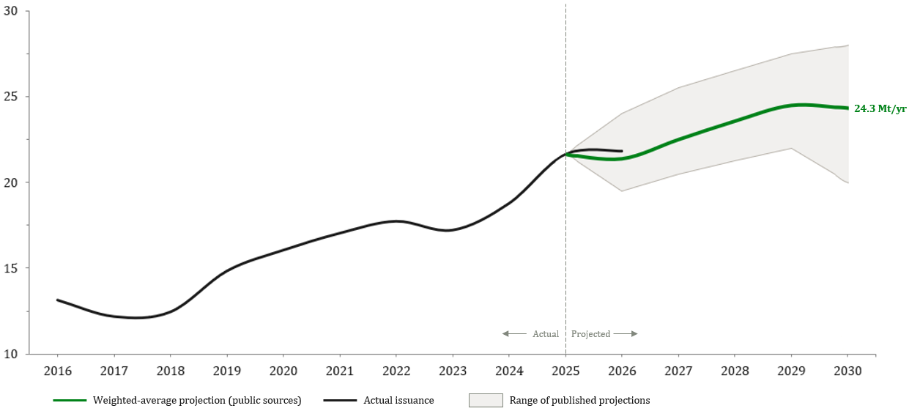
 Issuance of Australian Carbon Credit Units (ACCU) has climbed steadily since 2016, reaching 21.7 million ACCUs in the 2025 calendar year.1 This represents the highest issuance seen in any calendar year since the ACCU Scheme’s inception, exceeding the previous record set in the prior year.
A comparison of publicly available ACCU supply forecasts shows a consensus view that ACCU generation will continue to rise through to 2030 (refer to Figure 1). This is occurring despite the drivers of future issuance being increasingly distinct from those which shaped ACCU generation over the past decade.
Figure 1 Australian ACCU SUpply: Actual Issuance vs Published Projections (2016-2030)
Historical supply drivers differ from future drivers
ACCU generation has historically been shaped by a small set of activities, with 3 major supply pathways dominating:
- Native forest regeneration via the Human-Induced Regeneration (HIR) and Native Forest from Managed Regrowth (NFMR) methods
- Native forest protection via the Avoided Deforestation (AD) and Avoided Clearing of Native Regrowth (AC) methods
- Combustion of landfill gas via the landfill gas methods
However the ACCU scheme has evolved materially over time, with these legacy sources now either closed to new registrations, approaching the end of their crediting periods, or facing constraints that may reduce future issuance including the HIR regeneration gateway checks. As a result, future ACCU generation will increasingly depend on a different set of methods and project types than those that shaped supply over the past decade.
Deconstructing the factors influencing ACCU generation
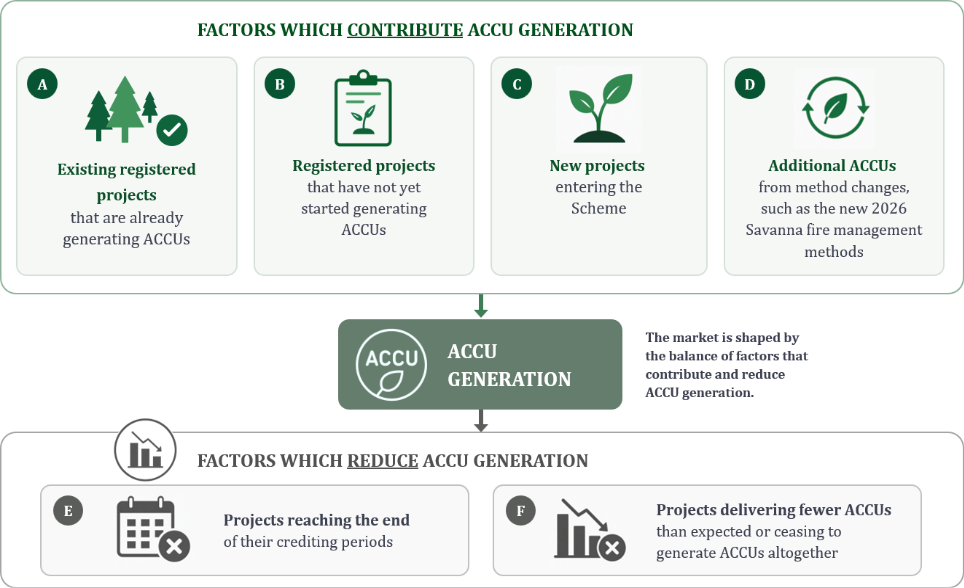
Beneath every supply projection is a set of assumptions about how projects enter, perform and eventually exit the ACCU scheme.
Figure 2 key factors influencing generation
Factors that contribute to generation
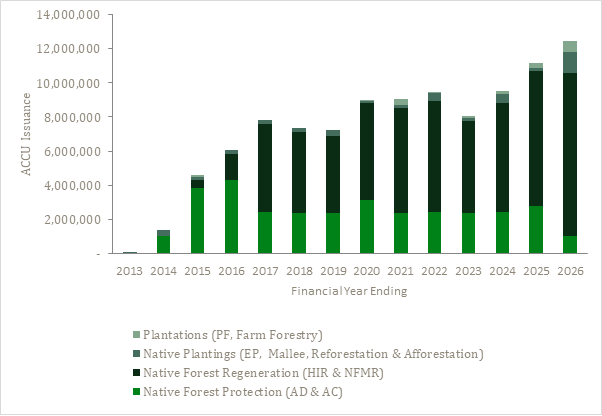
Most new project registrations are now associated with agricultural soil carbon, creation and management of plantations via the Plantation Forestry (PF) Method, and active bushland restoration via the Environmental Planting (EP) Method (refer to Figure 3), and projects registered under these methods are yet to produce ACCUs at the same scale as those registered under the older AD and HIR methods (refer to Figure 4).
Whilst PF and EP are generally more productive than forest protection or regeneration activities on a per-hectare basis, the projects are generally smaller. Costs per hectare are typically higher than AD and HIR and issuance typically progresses more slowly.
Soil carbon projects are also unlikely to translate registrations into generation in a linear way, because measured changes in soil organic carbon can vary materially between projects and over time, creating higher variability in ACCU generation per hectare. This matters because many soil carbon projects are relatively small, meaning aggregate supply may depend on a large number of projects each delivering modest and potentially variable crediting outcomes. Smaller projects may also face higher effective costs per hectare, as administration, sampling, reporting, verification and audit requirements do not always benefit from the same economies of scale as larger projects.
Figure 3 New ACCU project registrations by method, 2020–2026 (note: 2026 project registration is year-to-date)
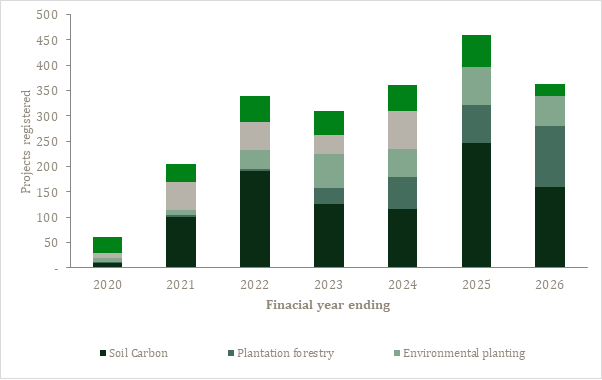
Figure 4 Annual ACCU Issuance (Vegetation Projects)
Factors that reduce Generation
While considerable attention is given to new sources of ACCU generation, the scheme will also be shaped by the rate at which existing projects stop generating credits. Projects reaching the end of their crediting period (Factor E) is most significant for AD projects, with 79% reaching the end of their crediting periods in 20252 and no new projects able to enter the method. The risk of a project delivering fewer ACCUs than expected or ceasing to generate ACCUs altogether (Factor F) applies especially to HIR projects, where future issuance will increasingly depend on performance at crediting gateway checks. Given the historical contribution of both methods to vegetation-based ACCU generation, shortfalls in ACCU generation will have a material influence on future supply.
Our view of future ACCU generation
ERM modelled ACCU several scenarios to better understand how these competing drivers could shape future ACCU generation (refer to Figure 5).
ERM’s modelling is best understood as a projection of underlying ACCU generation, rather than a complete measure of ACCUs available to the market. Generation reflects the volume of eligible abatement expected to be created by ACCU projects, while issuance occurs only when ACCUs are formally credited to ANREU accounts. A further distinction is market availability, which reflects the volume of issued ACCUs that is realistically available to buyers after accounting for inventories, surrenders, Commonwealth contract deliveries, private offtake commitments and other forms of withholding. Future generation is therefore a critical leading indicator of market supply, but market tightness and price outcomes ultimately depend on how that generation flows through issuance into available inventory relative to demand.
ERM employed a ‘bottom-up’ modelling approach which reflects the current ACCU scheme design and draws primarily on publicly available data from the Clean Energy Regulator, supplemented by informed assumptions where data gaps exist (e.g. additional ACCUs from method changes and projects delivering fewer ACCUs).
Figure 5 ERM projection of future ACCU Generation
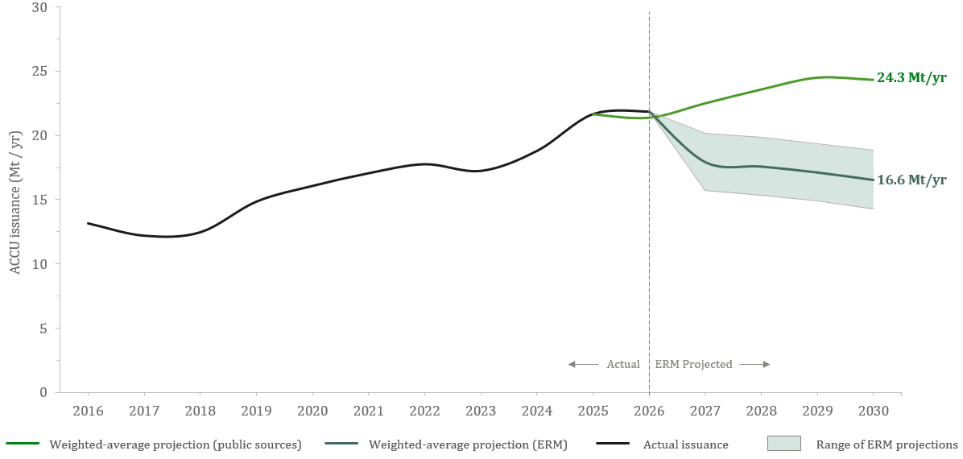
The analysis points to a different outcome from the prevailing market consensus. As legacy sources of ACCU issuance decline, newer methods may struggle to scale quickly enough to offset lost supply. As a result, annual ACCU generation is projected to trend downward, creating a materially tighter market than many published forecasts currently suggest.
The difference between ERM’s bottom-up analysis and some publicly available forecasts may partly reflect differences in scope and method assumptions. Higher forecasts may be incorporating broader scheme-growth factors that ERM has not explicitly modelled, including the introduction of new methods, future registrations and more optimistic assumptions about the rate at which registered projects convert into credited ACCUs. This distinction is important because a forecast based on potential scheme expansion can imply a materially higher supply outlook than one grounded primarily in the current method set, observable project base and known constraints on legacy generation.
What does this all mean?
Differences between ERM's projection and some published forecasts largely reflect differing assumptions regarding future project registrations, method development and project performance. Actual ACCU generation could fall short of published projections if assumptions concerning project activation, new registrations and additional generation from method changes prove too optimistic, or if insufficient weight is given to delays, underperformance and projects ceasing to generate. If newer sources do not replace declining legacy supply, competition for available ACCUs could increase more quickly than expected, placing upward pressure on prices and increasing procurement and delivery risk.
As the ACCU market evolves, participants may need to look beyond how they access ACCUs and place greater emphasis on understanding how ACCUs are generated and ultimately made available to the market. Market participants should therefore look beyond headline registration numbers and aggregate supply forecasts and scrutinise the underlying assumptions concerning method uptake, project size, delivery timing, crediting variability and the proportion of generated ACCUs that ultimately becomes available to buyers. Greater transparency and scrutiny across generation, issuance and market availability will support more informed procurement and investment decisions, more effective price discovery and greater confidence in the market.
ERM’s market intelligence capability helps clients navigate this uncertainty by translating project-level data, method rules, issuance trends and regulatory developments into practical insights. Rather than relying solely on headline registration numbers or aggregate supply forecasts, ERM helps clients understand the drivers, constraints and timing risks that influence future ACCU supply and market availability.
For Safeguard buyers
If future ACCU supply grows more slowly than current projections suggest, facilities regulated under the Safeguard Mechanism could face higher compliance costs, greater procurement risk and increased exposure to ACCU price volatility. Buyers relying heavily on future spot-market purchases may benefit from securing access to ACCUs early increasingly valuable to hedge future ACCU pricing and delivery risks.
ERM supports clients to develop carbon acquisition strategies that are grounded in a detailed understanding of future compliance obligations and the realities of ACCU market supply. Our carbon accounting expertise enables rigorous forecasting of future unit requirements across a range of production, emissions and abatement scenarios, while our market intelligence capability provides insight into the factors that influence future ACCU generation, availability and pricing. Combining these perspectives, we help clients design and optimise carbon portfolios across procurement, investment and development pathways, enabling informed decisions about when and how ACCUs should be secured to manage cost, delivery and market risks over time.
For investors and traders
A weaker supply outlook could place upward pressure on ACCU prices if the market has not fully priced the risk that future generation, issuance and availability fall short of current expectations. Investors and traders should closely monitor project activation rates, HIR gateway check outcomes and the scalability of newer methods, such as the proposed Integrated Farming and Land Management (IFLM) method. Underperformance of supply growth factors could make ACCUs scarcer and more valuable than current market expectations.
ERM provides independent technical and commercial scrutiny of ACCU project opportunities. We help investors and traders distinguish credible opportunities from those that may be delayed, underperform or fail to reach market. This includes assessing project eligibility and execution risks, developer capability, and the assumptions underpinning forecast ACCU generation.
1Clean Energy Regulator (2026) Quarterly Carbon Market Report December quarter 2025, https://cer.gov.au/markets/reports-and-data/quarterly-carbon-market-reports/quarterly-carbon-market-report-december-quarter-2025/australian-environmental-markets
2Clean Energy Regulator (2026) ACCU Scheme Project Register, Data as at COB 31/05/2026, ACCU project and contract register | Clean Energy Regulator