
 View all
 Reporting season is starting to gain momentum, companies are publishing their financial results, and Annual and Sustainability Reports are coming thick and fast. We are analysing these reports as they come available and augmenting the reporting database we started to build earlier this year. As a quick summary, we are seeing similar maturity in the reporting pillars compared to the calendar year reporters; reporting in the Governance pillar is most advanced and scores 83%, Risk Management scores 70%, Strategy is slightly less advanced than Risk at 67% and Metrics and Targets is least developed at 61%.
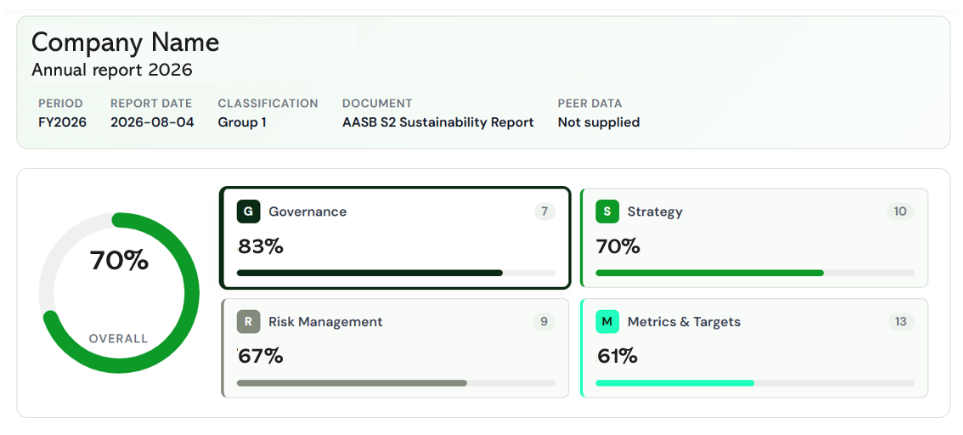
We inform this database using our proprietary AI engine that has been built to extract a standard dataset from the reports. We are working through the detail of what is, and what is not, being disclosed in support of our advisory work for you. The possibilities to query the data set are almost limitless, for example we can tell you how many companies have disclosed a carbon price, what scenarios have been used, and when and how the financial impacts of climate change have been estimated.
This standard dataset also allows us to look at how disclosures are developing, where in the market strengths lie, and where there is room for improvement. In order to do this, we have developed an approach to assessing reports based on completeness and quality. The picture above is an illustration of a dashboard response from the AI agent. If you would like to understand this information for your disclosure please contact us.
In our review of the calendar year reports we made a number of observations:
- In the main, reports were done well, which is to be expected given that the reports have all passed audit and board scrutiny.
- Governance as a pillar was strong, with Risk being addressed almost as well.
- The technical details of Strategy and Metrics and Targets were less robust.
For these early reporters we saw a difference in sectoral responses, Energy and Mining, who have faced significant shareholder pressure on their climate performance in the past, had rigorous disclosures. Other sectors were less mature.
At time of writing there are not yet enough financial year reports in the market to update our detailed sectoral analysis. We have however, assessed the reports available.
It was possible to extract themes from this analysis, these are summarized in the table and compared with our previous findings for the calendar year reporters.
Calendar Year reporters
| Disclosure strengths | Opportunities for improvement |
|
Strong governance disclosure Risk identification and enterprise risk integration Scenario analysis coverage and alignment Scope 1 & 2 emissions measurement and assurance Policy alignment and regulatory framing Transparency about current limitations |
Financial quantification of climate risk Linkage to financial statements Scope 3 emissions measurement Climate‑aligned capital allocation Revenue / scale context Quantified scenario outputs Metric consistency Execution detail behind targets |
Early Financial Year reporters
| Disclosure strengths | Opportunities for improvement |
|
Board oversight and accountability Defined governance and committee structures Management roles, controls and reporting lines Identification of climate risks and opportunities Use of board skills matrices and capability disclosures |
Transition plans not sufficiently developed Limited quantification of financial impacts Weak Scope 3 and value-chain analysis Scenario analysis not decision-useful Limited climate-linked remuneration Enterprise Risk Management integration not fully demonstrated |
There is an interesting mix of governance structures and processes in the strengths of the early financial year reports. We did a deeper dive into this aspect of the disclosures, and came to the conclusion that there are some common steps that can be taken to strengthen this organisational aspect.
Common governance elements that you might consider as you look through your reports are included in the table below.
|
Area |
Current State |
Leading Practice |
|
Remuneration |
ESG broadly referenced |
Climate-specific KPIs disclosed |
|
Accountability |
Board oversight |
Named executives or executive roles accountable |
|
Capability |
Skills matrix |
Skills matrix,training and competency assessment |
|
Disclosures |
A focus on qualitative |
Quantified performance outcomes |
We will continue to update our analysis and let you know what we are finding regularly. We will also extract sectoral results, so watch out for our assessment of disclosures across Mining, Energy, Infrastructure, Finance, and Property and REITs in coming weeks.