
 View all
We have completed our review of the FY26 annual reports and summarise the breadth of our findings in the illustration below.
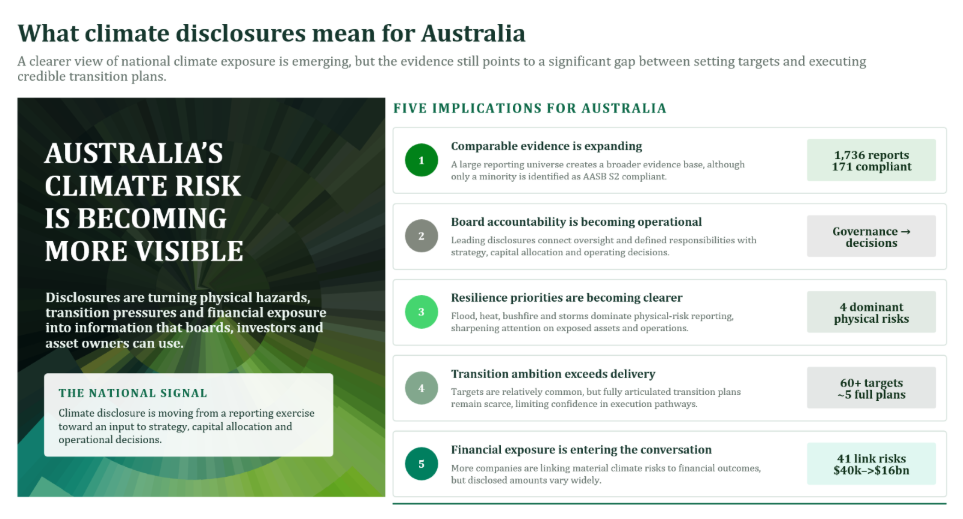
Our findings from this analysis align with previous observations relating to where the strengths and gaps in reporting lie. We felt there was value in taking a step back and looking at what AASB S2-aligned reports mean for Australia and the Australian economy. Our first wave of climate-related financial reporting represents far more than the publication of another set of corporate disclosures. Across more than 200 ASX-listed company assessments spanning corporate, energy, finance, infrastructure, manufacturing, mining, property and public-facing sectors, the reports show climate change moving from the margins of sustainability reporting into the core disciplines of governance, strategy, risk management and financial reporting. The significance of this cannot be understated; combined, these companies represent around 78% of the Australian equity market and a market capitalisation value of around $3.3 trillion.
As an initial point of departure it is clear from our analysis that Australia has gained a market-wide climate-risk information infrastructure: clearer accountability, more comparable risk and emissions information, stronger organisational capability, and a better evidence base for assessing corporate preparedness. Indeed, this increased infrastructure will serve Australia well in the face of sources of uncertainty outside climate change - the impact of AI and the current energy market shocks come to mind. Australia’s economy is more resilient as a result of mandatory climate disclosures.
The observed shift is an impressive national achievement. It reflects an enormous effort by boards, executives, finance teams, risk professionals, sustainability specialists, operational leaders, legal advisers, advisory firms and assurance providers. Companies have had to establish or uplift governance arrangements, interpret new requirements, assess complex risks, conduct scenario analysis, collect emissions data, develop controls and explain how climate change could affect their businesses. Boards have also started to upskill, so they are better equipped in challenging the content of their climate reports.
The result is not yet a perfect reporting system. Significant gaps remain, particularly in financial quantification, transition planning and evidence of capital deployment. Nevertheless, Australia now has a much stronger information base for understanding climate-related risks, corporate preparedness and economic resilience.
Here, we summarise what is done well, and how this has delivered a better Australia. We discuss the recommended next activities that will deliver best results for our economy as well as the reporting companies. This is built on a more detailed analysis which is available in the appendix below.
Where have we moved the dial?
|
Theme |
What companies are doing well |
Why it matters |
|
Governance has moved climate risk into the boardroom |
Strong governance structures have been established, with boards holding ultimate accountability and climate oversight delegated to audit, risk or sustainability committees. Clear reporting lines, management responsibilities and escalation pathways are now common. |
Climate risk is less likely to remain an unmanaged issue when ownership, controls and reporting responsibilities are formally documented. Stakeholders also gain confidence that climate issues receive board-level attention. |
|
Board capability is improving |
Companies increasingly disclose board and committee climate expertise through skills matrices, director experience, climate training, external advisers and capability assessments. |
Demonstrates that climate competence is being actively developed and monitored rather than assumed, supporting stronger governance and decision-making. |
|
Climate risks and opportunities are clearly identified |
Companies consistently distinguish between physical and transition risks, define relevant time horizons and explain exposures affecting operations, assets, customers, supply chains and markets. |
Creates a comprehensive picture of climate vulnerability across the economy and helps investors, lenders, regulators and governments understand concentrations of risk. |
|
Physical and transition risk assessment is becoming more sophisticated |
Reports identify recurring physical risks (floods, bushfires, drought, heat, cyclones, sea-level rise) and transition risks (carbon costs, regulation, technology change, insurance availability, customer expectations and supply-chain disruption). |
Improves understanding of how climate-related disruptions could affect assets, infrastructure, financial systems and communities. |
|
Scenario analysis is now an established discipline |
Companies routinely assess multiple climate pathways, including both low- and high-warming scenarios, using recognised external datasets and considering impacts over short-, medium- and long-term horizons. |
Encourages organisations to test resilience against different futures, identify vulnerabilities and make better-informed strategic decisions under uncertainty. |
|
Metrics, emissions and targets are more transparent |
Most companies disclose complete Scope 1 and Scope 2 emissions, climate-related metrics, target years, baselines, interim targets, current performance and longer-term decarbonisation commitments. |
Supports comparability, accountability and improved data quality while creating a common foundation for future reporting maturity. |
|
Organisations have built significant internal capability |
Reporting has required integration of climate science, finance, risk management, governance, scenario analysis, emissions measurement, assurance and legal expertise. Many organisations have established cross-functional teams, new policies and upskilling programs. |
Australia has developed substantial climate-related organisational capability that extends beyond compliance and can support better planning, investment decisions and risk management. |
|
A common climate risk language is emerging |
Boards, executives, finance teams, investors and regulators increasingly use shared frameworks, metrics and reporting approaches. |
Improves communication, consistency and decision-making across organisations and the broader economy. |
|
Overall outcome |
Climate reporting has driven significant improvements in governance, risk management, strategic planning, metrics and organisational capability. |
The benefits extend beyond compliance, creating stronger institutions and better-informed responses to climate-related financial risks. |
Current maturity gaps
|
Theme |
Most obvious gaps |
Why it matters |
|
Companies are stronger at governance than quantification |
Reporting is strongest in governance, risk identification and process descriptions, but significantly weaker in quantifying climate exposure. Transition-risk exposure metrics are often weak or absent, while physical-risk exposure metrics are frequently underdeveloped. Companies commonly identify risks without quantifying the assets, earnings, revenue, operational capacity or financial losses at risk. |
Users can understand what risks exist, but often cannot assess their magnitude, materiality or potential financial impact. |
|
Scenario analysis must become more consequential |
Scenario analysis is widely undertaken but is rarely linked to decision-making. Most reports do not explain whether scenario outcomes changed risk ratings, influenced controls, altered forecasts, informed impairment assessments, or affected investment and capital planning decisions. |
Scenario analysis creates greater value when companies demonstrate how it influences strategy, investment choices and management actions rather than simply describing modelling exercises. |
|
Executable transition plans need funding and clear targets |
More than 97% of companies disclose targets and initiatives but fail to present a comprehensive transition plan. Common gaps include interim milestones, accountable owners, implementation schedules, dependencies, investment requirements, constraints and progress measures. Climate-related capital allocation disclosures are similarly weak, with limited information on funding commitments, project pipelines or expected outcomes. |
Targets become more credible when supported by a funded, actionable roadmap that demonstrates how emissions reductions or resilience objectives will actually be achieved. |
|
Financial effects and methodologies require greater depth |
Quantification of current and future financial impacts remains limited. Many companies do not disclose impacts on cash flows, asset values, impairments, insurance costs, financing costs or access to capital. Methodological disclosures for GHG calculations are often incomplete, with gaps relating to boundaries, consolidation methods, emissions factors, estimation techniques and data quality. Internal carbon pricing and climate-linked remuneration disclosures are also frequently underdeveloped. |
Investors and other stakeholders need greater transparency to assess financial exposure, compare performance and understand whether climate considerations are genuinely embedded in business decisions, incentives and reporting systems. |
|
Overall implication |
The main challenge is no longer identifying climate risks or creating governance structures. The next stage of maturity requires quantifying exposure, linking analysis to decisions, funding transition plans and integrating climate considerations into financial management and accountability mechanisms. |
Future reporting quality will be judged less by the existence of processes and more by evidence of financial significance, management action and measurable implementation. |
The next phase should build on what Australia has achieved
The reporting regime has not eliminated Australia’s physical climate exposure, guaranteed successful transitions or resolved uncertainty. What it has done is make risks, assumptions, governance arrangements and preparedness more visible. That allows users to distinguish more effectively between companies that have integrated climate considerations into their businesses and those that have primarily met the reporting requirement.
The next dividend must come from converting this foundation into better decisions and measurable outcomes. Companies must quantify their exposures and financial effects, show how scenario analysis changes priorities, disclose capital commitments, build executable transition plans and connect management accountability to delivery. In doing so they will have better management of transition risks, enhanced competitiveness and improved climate resilience as well as improved access to capital.
The first wave has made climate risk more visible and governable. It has required substantial effort and delivered genuine national value. The next phase must preserve those gains while making climate reporting more financially connected, operationally specific and demonstrably consequential.
Find the detailed insights from the table in the appendix here.