

 View all
What do the COVID-19 pandemic, global supply chain disruption, climate change, cyber-attacks and artificial intelligence have in common? They all exposed the same reality: organizations that were designed for efficiency were not always prepared for disruption.
Over the last decade, businesses have faced an unprecedented combination of operational, environmental, technological, and regulatory challenges. Customers, regulators, investors, and supply chain partners now expect organizations not only to deliver consistent products and services, but also to demonstrate resilience, transparency, ethical leadership, and sustainable performance. ISO 9001:2026 is the standard’s response to this changing business landscape.
The world’s most widely adopted quality management standard is about to change in ways that go beyond editorial refinement. The Final Draft International Standard (FDIS) for ISO 9001:2026 has been released, confirming the direction of the revision and giving organizations the clarity they need to begin preparing for transition.
This update is the first meaningful revision to ISO 9001 since 2015. And in the decade since, the business landscape has shifted profoundly: sustainability expectations have accelerated, climate-related risks have moved from boardroom conversation to regulatory obligation, and customers, investors, and supply chain partners are demanding credible evidence that organizations are managing their impacts responsibly, and that they can remain resilient in the face of disruption. The 2026 revision of ISO 9001 reflects this new reality.
Most notably, climate change considerations are now explicitly embedded within the organization's context and interested-party requirements, reinforcing the connection between quality management, organizational resilience, and broader sustainability objectives. For quality management practitioners, this signals a fundamental repositioning of ISO 9001: no longer purely a framework for product and service consistency, it increasingly supports organizational resilience and future-ready business performance alongside its traditional quality objectives.
However, the revision goes beyond sustainability alone. It reflects a broader evolution in the definition of quality itself. Quality is no longer measured solely by product or service conformity. Increasingly, it is judged by an organization’s ability to anticipate change, manage risk, adapt to disruption, and deliver sustainable long-term performance.
At ERM CVS, we see this revision as a meaningful step forward, and one that is highly complementary to the equally significant update in the latest ISO 14001:2026 publication. Increasingly, ISO 9001, ISO 14001, ISO 45001, ISO 27001, and ISO 22301 are converging toward a single, integrated management system rather than functioning as independent, siloed standards. With ISO 45001 revisions expected to follow in 2027, organizations that start preparing now will be best positioned to build an integrated management system that reflects the full spectrum of sustainability, quality, safety and organizational resilience.
1. Why ISO 9001 still matters, and why the 2026 revision raises the bar
ISO 9001 is the world’s most widely adopted quality management system (QMS) standard, with over 1.47 million certificates worldwide (ISO Survey 2024). Organizations across every industry rely on it to consistently deliver products and services that meet customer and regulatory requirements, built on discipline, traceability, and continual improvement.
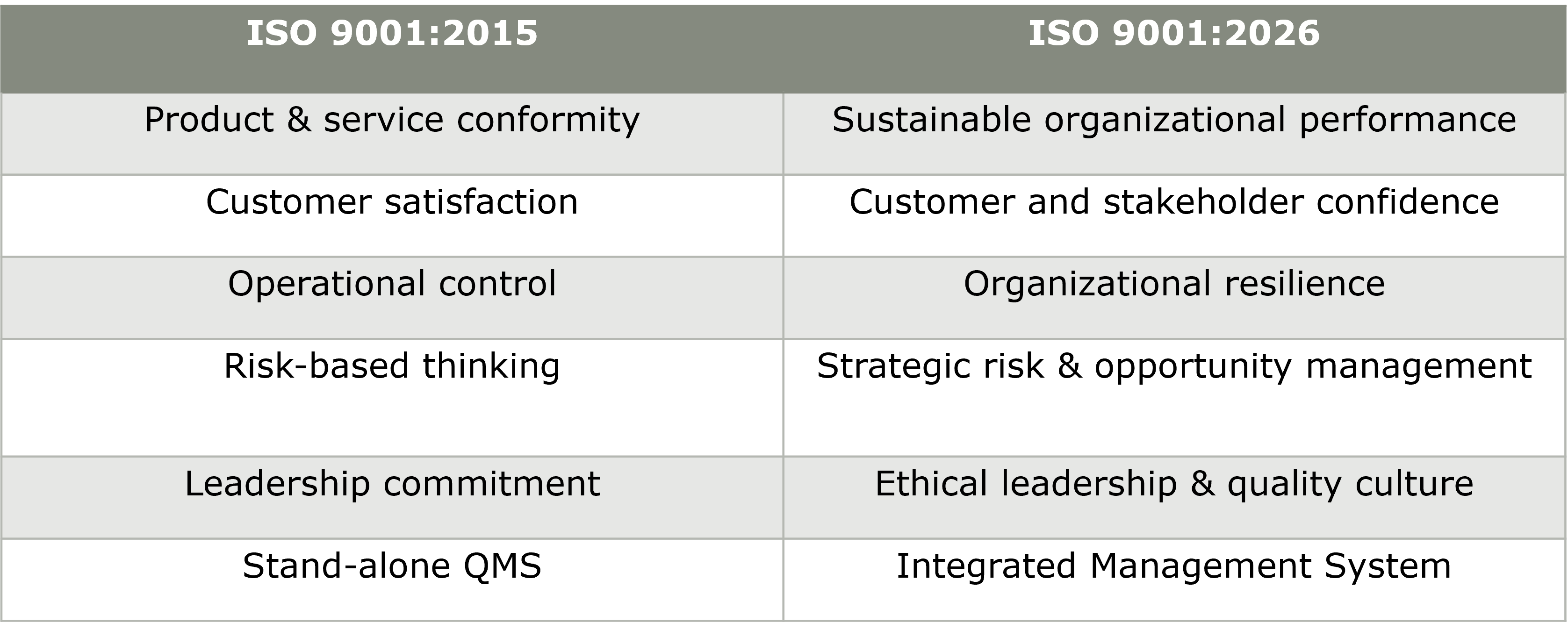
The 2026 revision does not dismantle that foundation. It strengthens and extends it, reflecting how much the definition of quality itself has expanded. Customers today do not evaluate quality in isolation. They assess it alongside how an organization manages its environmental footprint, its workforce, its supplier relationships, and its governance practices. Quality and sustainability have become inseparable in the minds of many stakeholders. The direction of this evolution is clear: from process effectiveness toward integrated business performance; from customer satisfaction toward customer and stakeholder confidence; from operational control toward organizational resilience; from risk-based thinking toward strategic risk and opportunity management; and from leadership commitment toward ethical leadership and quality culture.
The revised standard also deepens alignment with other ISO management system standards, including ISO 14001, ISO 45001, ISO 50001, ISO 27001, and ISO 22301. By reinforcing Annex SL structure and modernizing terminology, ISO 9001:2026 makes integrated management systems more practical and more coherent, allowing organizations to govern quality, environmental, safety, security, and business continuity performance through a single, unified framework rather than parallel and duplicative systems. This is part of a broader trend: rather than functioning as independent, siloed standards, ISO 9001, 14001, 45001, 27001 and 22301 are increasingly converging toward a single integrated management system.
2. Where are we now: ISO 9001:2026 FDIS status
The FDIS for ISO 9001:2026 has now been released for the final round of ballot and comments among ISO's national member bodies. This is the last formal step before publication.
Publication of the updated standard is targeted for around September 2026. Once published, all organizations currently certified to ISO 9001:2015 will be required to transition to the new version within a defined timeline. Based on current guidance from the global accreditation community, the transition period is expected to be three years from the date of publication.
The release of the FDIS effectively confirms the technical content of the standard. Organizations now have sufficient visibility into the requirements to begin structured preparation, assess gaps, develop transition plans, and build the internal competence needed to implement the changes effectively.
Early preparation reduces transition pressure and positions organizations to approach the updated requirements not as a compliance burden, but as a genuine opportunity to strengthen QMS performance and deepen ESG alignment.
3. How significant are the ISO 9001:2026 changes?
The overall extent of change in ISO 9001:2026 is considered moderate, and significantly less extensive than the 2015 revision. Organizations already certified to ISO 9001:2015 will see this as an evolution building on the existing implementation framework.
That said, “moderate” does not mean insignificant. Several of the changes reflect meaningful shifts in what credible quality management now requires, particularly around sustainability integration, leadership accountability, and ethical conduct. Beyond these headline changes, the revision also introduces targeted enhancements in areas such as organizational knowledge management, customer communication during disruptions, and clarification of infrastructure requirements for modern working environments. Together, these changes represent more than simple wording updates; they reflect a substantive evolution in the standard's expectations, and organizations that treat them as such will be better positioned to demonstrate the kind of quality culture that stakeholders increasingly expect.
The revision also introduces a substantially enhanced Annex A, the first Annex devoted specifically to clarification of structure, terminology, and clause intent. Spanning approximately 15 pages, Annex A provides important clarification on the structure, terminology, and clauses of ISO 9001:2026, and will support more consistent interpretation and application across organizations and audit functions.
Importantly, the FDIS also confirms what has not changed: the process approach, the PDCA cycle, risk-based thinking, customer focus, continual improvement, the context of the organization, interested parties, and leadership commitment all remain central to the standard. This is a deliberate evolution, not a reinvention.
4. Key ISO 9001:2026 changes: what organizations need to know
Climate change is now an explicit requirement
Clause 4 now explicitly requires organizations to determine whether climate change is relevant when assessing the internal and external factors shaping their QMS, embedding the 2024 amendments into the core of the standard. The primary changes are in Clauses 4.1 and 4.2, with supporting implications for Clause 4.3 (scope) and 6.1 (risks and opportunities).
In practice, environmental factors can no longer sit outside quality. Organizations facing climate risk, resource constraints, or increasing regulation must reflect these in how their QMS is scoped, planned, and governed. Many organizations increasingly use ISO 9001 as part of the management system framework that supports broader ESG and sustainability objectives. It is worth being precise about what this means in practice: ISO 9001:2026 is not becoming an ESG standard. Rather, it provides the management system that enables organizations to operationalize their ESG commitments in a structured, auditable way.
This update also strengthens alignment with ISO 14001:2026. Both standards now reinforce the expectation that environmental considerations are integrated into management decision making rather than treated as separate initiatives.
Quality culture, ethics leadership and accountability are strengthened
Clause 5 introduces stronger and more explicit expectations regarding leadership's role in promoting quality culture and ethical behavior. Top management must now actively promote a culture of quality and ethical behavior, not just support the QMS. The primary changes appear in Clauses 5.1.1 (leadership and commitment) and 7.3 (awareness), with supporting implications for Clause 7.1.4 (work environment).
The quality policy is expected to reflect organizational context and strategic direction, which may include climate-related and sustainability considerations where relevant to the organization.
In practice, this moves the standard beyond compliance. Culture and ethics must be visible in leadership behaviors, decisions, and communication, not just documented. It also aligns ISO 9001 with broader governance expectations. Customers, regulators, and investors increasingly expect integrity across operations and supply chains, positioning the QMS as a driver of trust and reputation.
For organizations with integrated systems, this strengthens alignment with ISO 14001:2026, reinforcing consistent leadership accountability across quality and environmental management.
Risk and opportunity are now addressed separately
Clause 6 separates risk management from opportunity-based thinking, strengthening focus on both. Risks are now addressed under Clause 6.1.2 and opportunities under Clause 6.1.3 as distinct, separately governed requirements.
In ISO 9001:2015, they were often treated together, which in practice meant one could be overlooked. The revised standard makes them distinct but equally important.
In practice, organizations must demonstrate clear approaches to identifying and controlling risks to QMS performance, alongside structured processes for pursuing improvement opportunities.
This is particularly relevant in a sustainability context. Climate risks to operations and supply chains must be managed, while opportunities such as efficiency gains, new markets, and stronger customer alignment must be actively pursued. ISO 9001:2026 reinforces the need to address both with equal rigor.
Change management receives strengthened requirements
ISO 9001:2026 reinforces the need for structured, controlled change management within the QMS. Organizations must demonstrate clear oversight of planned changes, ensuring QMS integrity is maintained, and intended outcomes are achieved. The primary changes are in Clause 6.3, with supporting implications across Clauses 5.3, 8.1, 8.2.1, 8.2.4, and 9.3.
Greater emphasis is placed on communication, monitoring, evaluation, and review of changes. This closes a common gap where changes were implemented without sufficient planning or follow-through.
For organizations with integrated systems, this aligns with ISO 14001:2026, supporting a consistent and more disciplined approach to change governance across quality and environmental management.
Awareness and training encompass quality culture
Clause 7 expands awareness requirements to include quality culture and ethical behavior, with primary changes in Clauses 7.2 (competence) and 7.3 (awareness) and supporting linkage to Clause 7.4 (communication). Employees must understand not only QMS processes, but how quality and ethics apply in day-to-day decision-making.
This has clear training implications. Organizations will need to go beyond procedural training and embed values, behaviors, and culture into onboarding and ongoing communication.
For those already investing in sustainability awareness, this creates an opportunity to integrate quality culture into broader workforce programs.
A New Annex A provides substantial guidance
ISO 9001:2026 introduces a substantially expanded Annex A to support interpretation and consistent application of the standard. This supplementary guidance clarifies structure, terminology, and key clauses, helping organizations interpret requirements more consistently.
For internal auditors, system owners, and advisors, Annex A provides a practical reference to support more effective and aligned implementation across different organizations and sectors.
5. ISO 9001:2026 transition timeline: what to expect
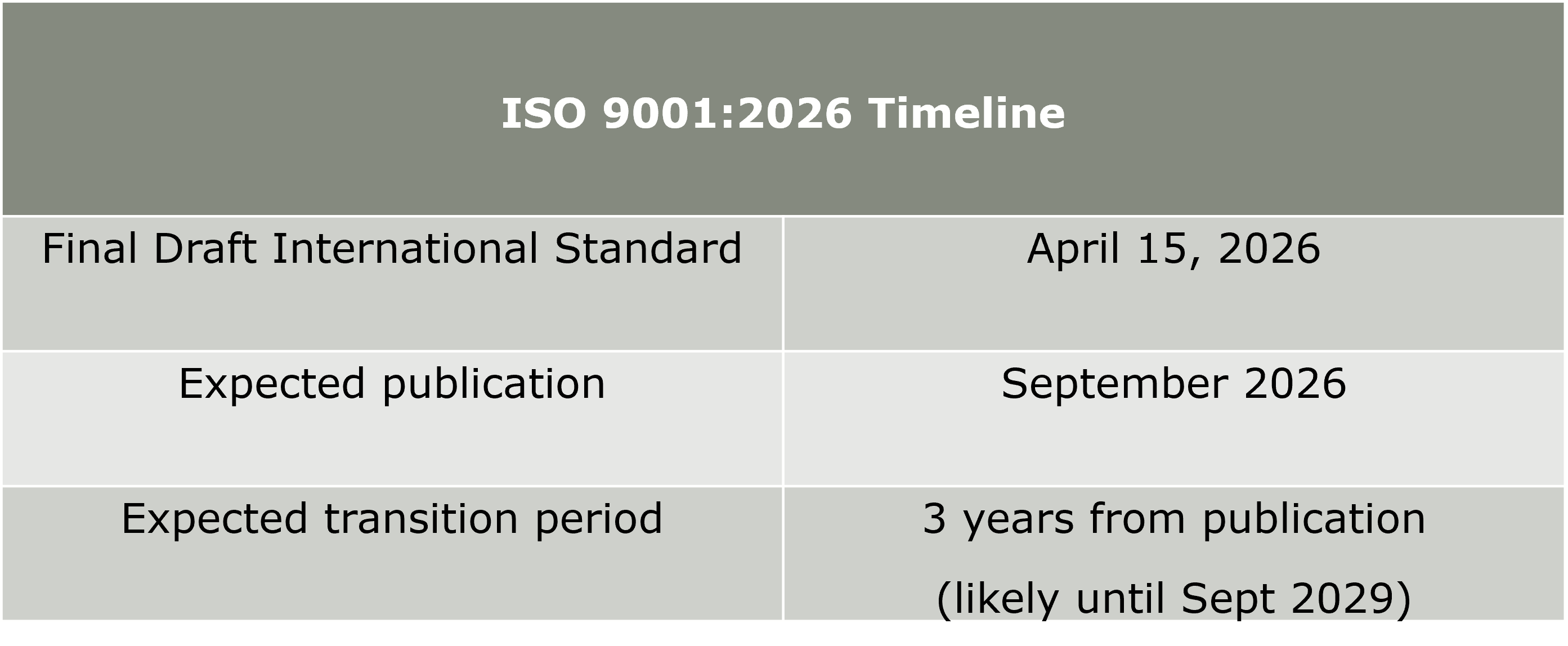
The FDIS publication marks the final technical milestone before the standard is formally released. Publication is targeted for September 2026.
Once published, certified organizations will enter a transition period expected to last three years, based on current draft guidance from the global accreditation community. Formal transition rules, including specific dates and audit requirements, will be issued by IAF and accreditation bodies after publication.
However, the direction and content of the changes are now clear and give a good indication of what is to come. Organizations do not need to wait for formal transition dates to begin preparing. Acting early means less pressure later, more time to build internal competence, and a smoother audit cycle when transition audits are conducted.
6. The sustainability connection: why ISO 9001:2026 and ISO 14001:2026 work better together
The updates to ISO 9001:2026 and ISO 14001:2026 reflect the same shift: embedding sustainability into core management systems.
ISO 14001:2026 deepens requirements around climate, biodiversity, lifecycle thinking, and supply chains. ISO 9001:2026 brings climate change and sustainability directly into the QMS context.
Together, they create a more powerful, integrated framework. Quality and sustainability move from parallel initiatives to a single, coordinated system that strengthens performance, efficiency, and strategic value. The revised standard can be readily mapped to many ESG governance and management practices. On the environmental side, Clauses 4.1, 4.2, 6.1, and 9.3 require organizations to assess climate change relevance, understand environmental expectations of customers and regulators, and address environmental factors that may affect products, services, or business performance. On the social side, Clauses 7.1.2, 7.1.4, 7.2, 7.3, and 7.4 provide the framework for developing competence, strengthening awareness, engaging employees, and promoting quality culture and ethical behavior. On the governance side, Clauses 5.1 through 5.3, 6.2, 9.1, 9.3, and 10.3 establish accountability, monitor objectives and performance, conduct effective management reviews, and drive continual improvement.
For organizations already preparing for ISO 14001:2026, many changes, particularly around sustainability integration, leadership, and change management, carry directly into ISO 9001:2026. Shared structure and terminology make alignment straightforward.
Looking ahead, ISO 45001 is expected to follow. Organizations that take a coordinated approach now are building the foundation for a fully aligned system across quality, environment, and safety.
7. Act now: A practical approach to ISO 9001:2026 transition planning
Early preparation for ISO 9001:2026 is not about rushing to implement changes before the standard is formally published. It is about using the clarity provided by the FDIS to begin structured, deliberate preparation so that the transition is managed confidently rather than reactively.
Practical early actions include:
- Understand the direction of changes
- Familiarize key personnel with the FDIS updates, particularly the sustainability and climate integration in Clause 4, the quality culture and ethics expectations in Clauses 5 and 7, the separation of risk and opportunity in Clause 6, and the enhanced change management requirements.
- Assess your current QMS against the updated requirements
- Identify where gaps exist, particularly around sustainability integration, leadership accountability, and cultural awareness. This does not require a formal audit, but it does require an honest and structured review.
- Plan and prioritize competence building: internal auditors, QMS coordinators, and operational personnel will all need updated knowledge. Training against the revised requirements should be planned early, not left until the transition deadline approaches.
- Consider integration opportunities: if your organization also holds ISO 14001 certification, the overlap in sustainability, governance, and change management requirements between the two 2026 revisions creates a real opportunity to plan an integrated transition. Engaging ERM CVS early allows you to design an efficient, coherent approach across both standards.
- Stay connected to your certification body: accurate, up-to-date guidance from an experienced certification body is essential as transition rules are formalized. ERM CVS will provide proactive communication and practical support at every stage.
8. Why the ISO 9001:2026 transition matters and how ERM CVS supports you
ISO 9001:2026 is more than a compliance update. For organizations that approach it strategically, it is an opportunity to demonstrate that quality management is genuinely aligned with the expectations of today's customers, investors, and supply chain partners.
Organizations that treat ISO 9001:2026 as a strategic upgrade, rather than a certification box-tick, will emerge from the transition with a more mature, more credible, and more future-ready quality management system.
ERM CVS offers a comprehensive range of services to support organizations through the ISO 9001:2026 transition, including:
- Specialized ISO 9001:2026 transition training - Ensuring teams gain the knowledge and competence needed to interpret and apply the strengthened requirements effectively. Find out more on our ISO 9001 transition training course here.
- Readiness reviews & transition planning - Providing a structured roadmap that identifies required updates and helps organizations implement changes with confidence.
- Gap assessments (pre audit reviews) - Identify exactly where your existing QMS aligns with the new expectations and where focused improvements are needed, resulting in a targeted action plan.
- Transition audits - Delivered efficiently, often alongside your annual certification audit, minimizing disruption and helping you stay on track for timely certification. Find out more on our certification services here.
9. The shift in a snapshot: from compliance to resilience
Taken together, the changes described above amount to a shift in what quality management means in practice. The table below summarizes the direction of travel.
Conclusion: A new chapter for Quality Management
ISO 9001:2026 marks the beginning of a new chapter for the world's leading quality management system standard. By explicitly embedding climate change considerations, ethical behavior, and quality culture into its core requirements, while strengthening alignment with broader sustainability objectives, the revised standard reflects how profoundly the definition of quality has evolved.
For organizations already navigating the ISO 14001:2026 transition, the complementarity between the two standards is clear and strategically valuable. For those beginning their ISO 9001:2026 preparation, the message is equally clear: the changes are meaningful, the timeline is defined, and early action is the most effective path to a confident, well-managed transition.
ERM CVS is ready to support your organization at every stage, from understanding the FDIS through to formal transition certification. The countdown to publication has begun. Prepare early, build your team’s capability, and position your organization to lead with quality, sustainability, and integrity.
Prepare early, build capability, and lead with confidence. ERM CVS will guide your transition to ISO 9001:2026 every step of the way.
Contact us now for further information