

 View all
Sustainability has moved from a “nice to have” to a core driver of business value. At the same time, organizations are working under growing pressure from customers, employees, regulators, and investors to show that they manage quality and sustainability in a credible, consistent way. ISO 9001 sits right at this intersection of quality, trust, and long-term resilience.
1. The global risk and ESG context
The World Economic Forum’s Global Risks Survey* shows that climate and nature are now core business concerns, not side issues. Companies face shifting regulations, tough targets, and growing pressure to prove that ESG investments deliver measurable returns. The benefits are clear:
- Energy efficiency can cut costs by up to 30%,
- Circular economy strategies can reduce waste costs by 20–40%,
- Sustainability initiatives can save 5–15% annually.
Stakeholders are also paying attention with 81% of B2B decision-makers and 84% of employees care about environmental impact, while 67% of consumers want to hear about sustainability efforts and 90% trust eco-certifications more than company messaging.** Ethics are also under scrutiny, with 79% of U.S. anti-bribery cases involving third parties.*** In this environment, organizations need integrated structures that connect quality, sustainability, ethics, and risk into a single credible approach and ISO 9001 provides that framework.
2. ISO 9001 as a platform for sustainable performance
ISO 9001 is the world’s most widely adopted quality management system standard, with over 837,000 certificates across 1.25 million sites globally as of 2023.* Its strength lies in global recognition across more than 170 countries, flexibility for organizations of any size or sector, and a strong focus on customer satisfaction and continual improvement.
ISO 9001 supports operational efficiency, risk management, and compliance, and it aligns naturally with other standards such as ISO 14001, ISO 45001, ISO 50001, and ISO 27001. As the foundation for integrated management systems, it enables organizations to combine quality with environment, health and safety, energy, business continuity, and cybersecurity within one Plan-Do-Check-Act framework, helping manage ESG topics through a coherent structure rather than fragmented initiatives. Further information on Integrated Management Systems here
Beyond internal benefits, certification often opens doors to markets where large buyers and public sector bodies require certified systems as a condition of doing business.
More information on what’s involved in becoming certified can be found here
3. How ISO 9001 connects to ESG
ISO 9001 already supports environmental, social, and governance topics, and the coming revision makes those links more explicit.
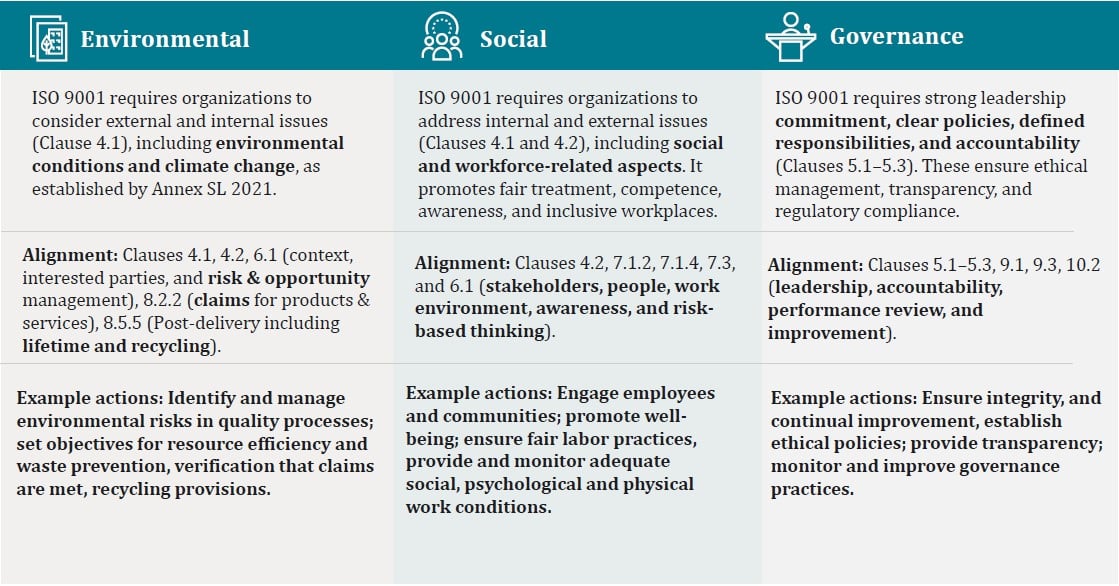
Environmental
The standard requires organizations to consider external and internal issues in their context analysis, including environmental conditions and climate change, and to manage related risks and opportunities. Clauses covering claims for products and services and post-delivery activities connect directly to lifetime, recyclability, and end-of-life treatment. Example actions include:
- Identifying and managing environmental risks in quality processes
- Setting objectives for resource efficiency and waste prevention
- Verifying that product claims, such as “recyclable” or “low carbon”, can be proven
- Planning for recycling and product lifetime in design and support activities
Social
ISO 9001 addresses social and workforce topics through clauses on people, work environment, and awareness. It promotes fair treatment, competence, and inclusive workplaces by asking organizations to provide and monitor social, psychological, and physical working conditions. Example actions include:
- Engaging employees and local communities
- Supporting wellbeing and stress prevention
- Ensuring fair labor practices and safe, supportive workplaces
Governance
On the governance side, ISO 9001 requires clear leadership commitment, defined roles, accountability, and effective performance review and improvement. This ties directly into ethical management and transparency:
- Establishing and communicating ethical policies
- Monitoring and improving governance practices
- Using audits and management reviews to drive continual improvement
Because of this, ISO 9001 can support broader ESG frameworks, Sustainable Development Goals alignment, and greenhouse gas reporting. ISO’s strategic partnership with the GHG Protocol on unified standards for emissions accounting further strengthens this link.
4. Upcoming changes in ISO 9001 and related standards
Several key ISO standards are in revision at the same time, which gives organizations a chance to refresh their management systems in a coordinated way. Current working timelines are:
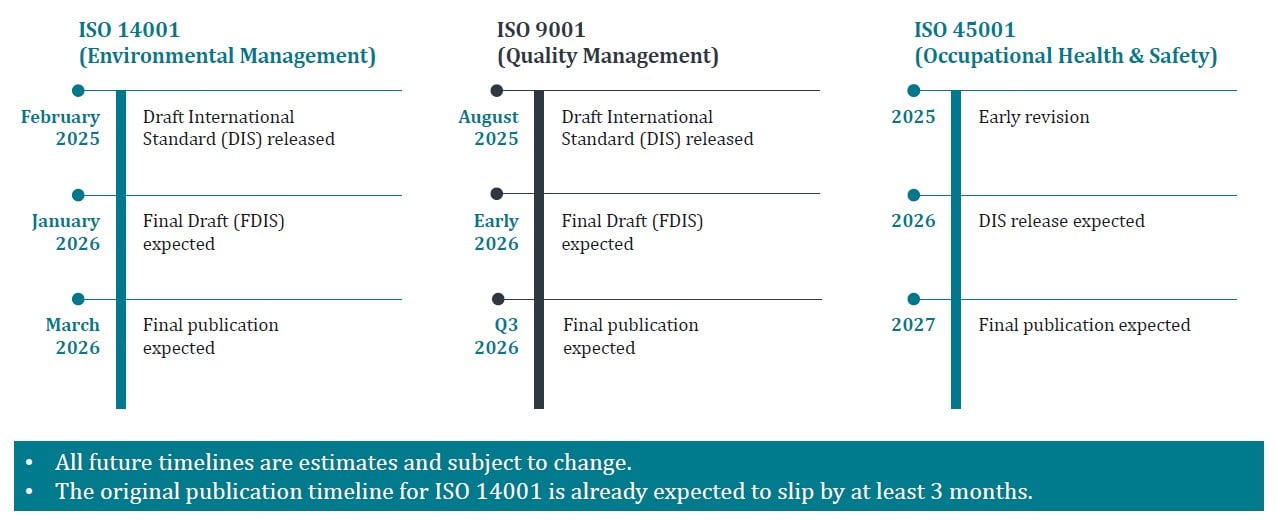
Timelines may shift slightly, but organizations can already see the direction for ISO 9001:2025. The DIS proposes:
- Stronger context and sustainability focus
Explicit integration of climate change and the three sustainability pillars in clauses on context and interested parties. - Ethical leadership and culture
Ethical behavior becomes an explicit leadership requirement, and awareness clauses refer to ethics as part of quality culture. - Risk, continuity, and resilience
Risk-based thinking expands to cover business continuity and disruptions, aligning with ISO 22301. - Lifecycle and responsible design
Product and service requirements emphasize sustainability, ethics, and customer experience, and post-delivery activities include lifetime, recycling, and disposal, in line with lifecycle thinking in ISO 14040 and 14044. - Technology and AI
Emerging technologies, including AI, must be assessed for ethical implications and accountability when replacing human functions.
Overall, many of the changes are clarifications that make expectations more precise rather than complete rewrites. Organizations already thinking in terms of ESG, ethics, and continuity will find that the new version gives clearer language for what they are doing.
Further information on what we know can be found on our ISO 9001 update paper here
5. People and skills: closing the gap
Technology and standards alone don’t drive transformation. The World Economic Forum study* on the future of jobs highlights skills gaps as the top barrier to organizational change between 2025 and 2030, followed closely by culture.
To embed quality and ESG into daily practice, organizations need people who can work across three skill groups:
- Technical and analytical skills
ESG metrics, greenhouse gas quantification, energy efficiency, risk and control assessment across environmental, social, and governance topics. - Interpersonal and organizational skills
Communication, collaboration, emotional intelligence, change management, health and wellbeing, inclusive leadership, and ethical decision-making. - Professional and adaptive skills
Digital literacy, analytical thinking, the ability to see links between frameworks, and resilience in the face of fast change.
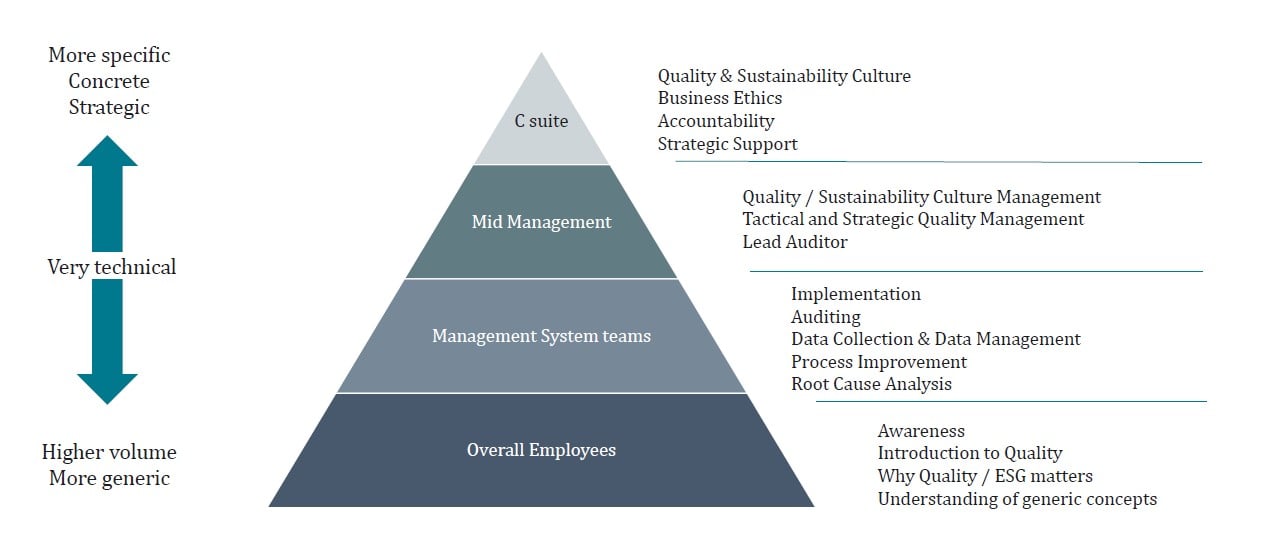
Knowledge needs according to roles should also be considered, where senior leaders need a strategic view of quality, ESG, ethics, and accountability; management system teams require expertise in implementation, auditing, and process improvement; and employees need awareness of why ESG and Quality matter and how their work connects to them.
To find out more on how training may help you build ISO 9001 audit capabilities here
6. Practical steps to act now
Organizations that want to use ISO 9001 to strengthen sustainability can start with a few practical next steps:
- Clarify objectives
Define how quality and sustainability should support business strategy, and what outcomes you expect in terms of efficiency, compliance, and growth. - Review context and risks
Update your context and interested party analysis to reflect climate change, ESG expectations, and business continuity. - Check leadership and ethics
Make sure leadership roles, policies, and behaviors clearly support ethical conduct, quality culture, and ESG commitments. - Update lifecycle thinking
Look at how products and services are designed, delivered, supported, and retired, and where environmental and social impacts occur. - Invest in skills and awareness
Plan targeted training and upskilling for different roles, and communicate clearly about upcoming changes to standards and internal processes. - Plan for the transition
When the Final Draft International Standard is released, conduct a gap assessment and prepare a 1–2 year transition plan in line with accreditation body guidance.
By treating ISO 9001 not just as a quality label but as a central management tool for ESG, risk, and resilience, organizations can respond better to today’s pressures and build long-term value for customers, employees, and wider society.
Contact us here or email now post@ermcvs.com
* The World Economic Forum’s Global Risks Survey
**ERM Global EcoPulse® 2025 – Globally weighted by subregion (n=5,673)
***Institute of Business Ethics – 2024 - putting the consumer at the heart of ethical business